Talk to enough product founders and you start hearing about the storage units. Pallets of version one, shrink-wrapped and stacked to the ceiling, bought to hit a factory’s 5,000-piece minimum and stranded the day version two shipped. The minimum order quantity quietly set the company’s entire risk model, and it was set by someone else’s tooling economics.
Merit3D runs production additive manufacturing with no minimum order quantity. That is a standing fact of how the process works, and it changes sourcing math enough to be worth walking through properly — including the trade-offs, because MOQ-free is a real advantage with real limits.
Why minimums exist in the first place
A minimum order quantity is amortization turned into policy. Traditional part pricing assumes the cost of the mold gets spread across enough units to disappear into the piece price, and everything downstream reinforces the same logic:
- Tooling — the mold is a serious capital object, and small orders can’t absorb it.
- Changeover — tearing down and setting up a molding press eats hours; short runs waste them.
- Material purchasing — pellet resin is a bulk commodity, bought by the ton.
- Scheduling — a machine that earns money by the hour hates a two-hour job with a four-hour setup.
The minimum protects the factory’s math, and the factory’s math starts with the mold. We wrote about what tooling really costs mid-volume parts if you want that thread pulled further.
What changes with additive
On our floor, the tooling is a build file and the mold room is a folder on a server. That one substitution rewrites every line above:
- No mold, no amortization. The first part and the ten-thousandth part carry the same tooling cost: zero.
- Setup is digital. Arranging a build plate takes about the same effort for 10 parts as for 100. Small orders stop being a scheduling insult and start being a normal Tuesday.
- Capacity scales by build plates. Need more parts, we run more plates on more machines. Our best day on one small part was 60,000 pieces in under eight hours.
- Design changes cost a file revision. Version two doesn’t strand version one inventory, because version one inventory never had to exist.
What ordering looks like
| Your situation | How it runs with no MOQ |
|---|---|
| Testing a market with a few hundred units | A build plate or two. Order again only if they sell. |
| Steady product, 1,000–10,000 per order | Our typical order size. Reorder when you need more. |
| Above roughly 50,000 pieces | We set up weekly shipments so the parts flow instead of piling up. |
| Reordering an old part | The file is on the shelf. Digital inventory costs nothing to store. |
Weekly shipments matter more than they sound. The point of skipping minimums is skipping the pallet farm, and it would be silly to rebuild one on your receiving dock.
There is a cash-flow reading of that table worth saying out loud. Inventory is cash wearing a disguise: every unit on a shelf is money that already left and hasn’t come back. When orders can be sized to actual demand, that cash stays liquid, funding marketing, the next SKU, and payroll, instead of sleeping in a warehouse waiting for the forecast to come true.
The honest trade-offs
Two limits, stated plainly. First, piece price: at very high volumes with a stable design, a fully amortized mold eventually wins on cost per part. Where that crossover sits is the subject of our volume math breakdown, and for some parts the right answer is genuinely a mold — sometimes with printed parts bridging production while the tool is cut. Second, the menu: production resins cover rigid, impact-resistant, and flexible jobs well, but the material and color range is narrower than thermoplastics. Black, white, and amber off the printer, with Cerakote (a ceramic coating) when a part needs more color range or surface durability.
If your part needs glass-filled polypropylene in seven colors at a million a year with a design frozen for a decade, cut the mold. We will tell you that in the quote.
Who no-MOQ fits
- Launches. Sell 400 before you commit to 5,000. Inventory risk moves from a leap to a step.
- Seasonal and event runs. We produce race medals for Red Rock Events run by run, with zero upfront capital commitment, sized to each event.
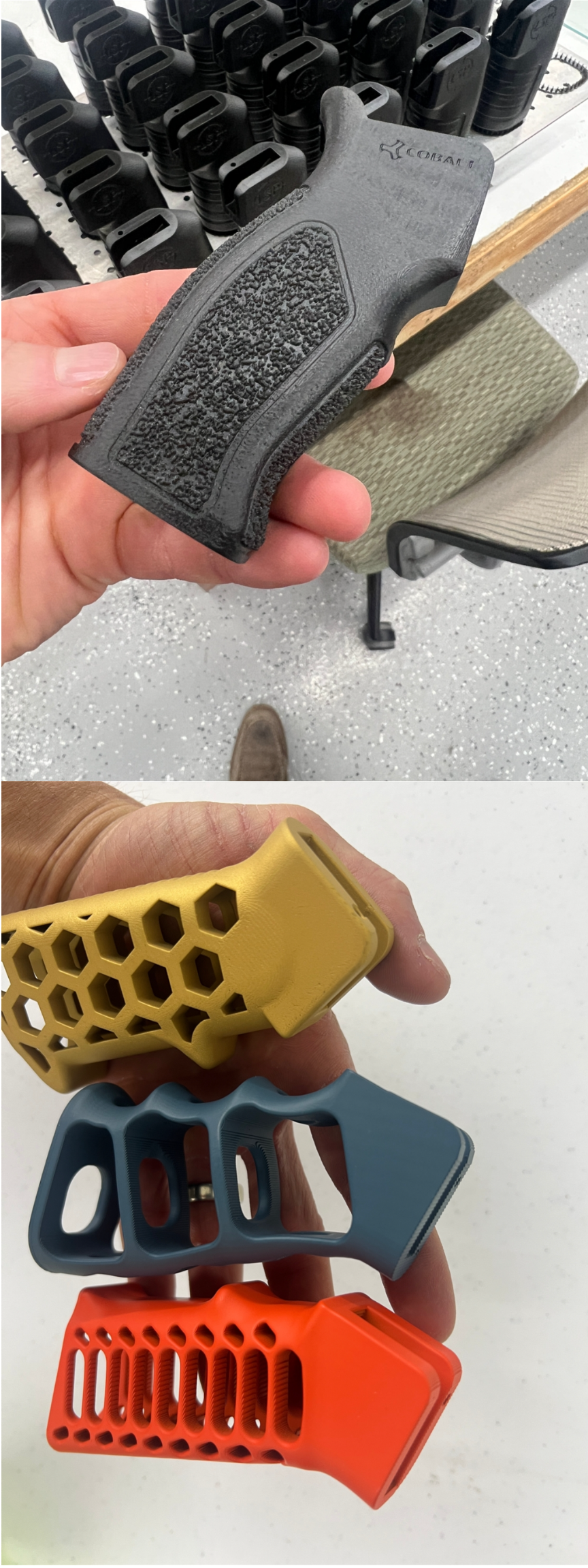
- SKU families. Twelve variants of a grip, each needed in the hundreds, would mean twelve molds. Here it means twelve files.
- Legacy spares. The original mold is gone, the supplier is gone, and demand is 80 units a year. Printed production keeps a discontinued machine alive without anyone financing new tooling.
- Anything still changing. If engineering wants one more revision, the cost of saying yes is a file update.
The part where it compounds
The founders with the storage units usually made a rational decision. The minimum forced a bet, they took the bet, and the market voted late. What no-MOQ manufacturing removes is the forced bet itself: every order becomes a decision sized to what you actually know about demand at that moment. Order small while you learn, order big when you’re sure, and change the design the week you learn something new.
Alaska Guide Creations started with us on small runs years before we ever printed 60,000 parts for them in a single day. The minimum order was whatever they needed that month.
It still is.
Ready to see what your part would cost? Upload a CAD file for an instant estimate, see what we run on our capabilities and materials pages, or talk to a real person about your project.