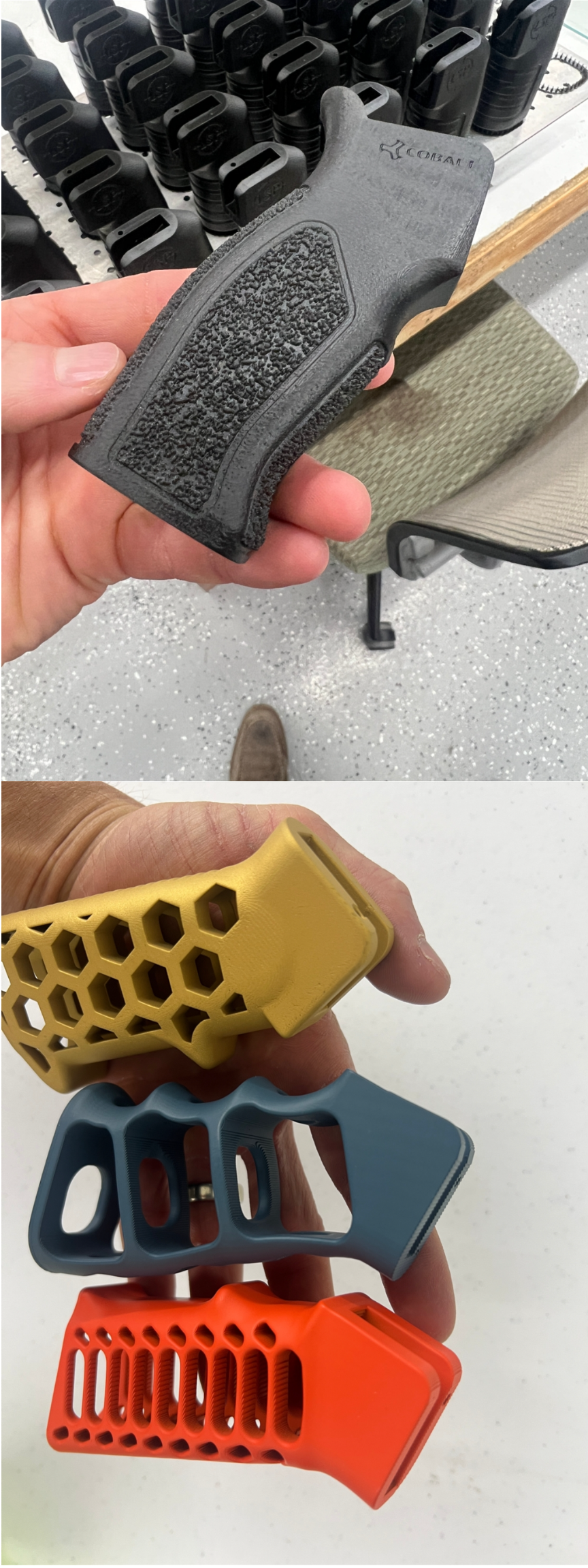
Some of our favorite parts ship inside someone else’s box. This one rides in Hutch Mountain’s conversion kits for the Honda GX390 engine, and 280 of them come off a single build plate in Price, Utah.
The problem
A kit business lives and dies on component supply. Hutch Mountain sells conversion kits built around one of the most common workhorse engines in America, which means steady demand for a plastic component that looks, at first glance, like an obvious injection molding candidate.
But obvious is not the same as easy. A mold means committing capital against a forecast, waiting out the tooling lead time, and accepting that every future design revision carries a tooling cost. For a product line that improves as the kits evolve, the mold is not just an expense. It is an anchor.
What we did
We did not port the molded-style design one-to-one. The geometry was reworked for the process: shaped and oriented so 280 parts nest on a single plate, the way you see in the photo, and print reliably run after run.
That rework step is where the value hides. A one-to-one port to additive usually works, but it leaves plate density and print time on the table. Letting the process influence the design is what makes the per-part price hold up at kit volumes: denser plates, fewer operations, and revisions that cost a file change instead of a mold change.
Production now runs as continuous flow. Racks come off the machines, parts go into kits, and there is no tooling anywhere in the building to maintain, insure, or amortize.
The numbers
- 280 parts per build plate
- 0 molds cut, 0 tooling lead time
- A design revision ships as easily as revision one
- No minimum order forced by tooling amortization
The redesign is where the money is
If you take one thing from this part: the biggest savings in moving to additive rarely come from swapping processes on an unchanged design. They come from the afternoon an engineer spends letting the printer’s rules, instead of the mold’s rules, shape the part. We wrote more about that mindset in Quit Drawing Molded Parts.
Get a number for your part
Upload a CAD file for an instant estimate, ask us what a process-native redesign would look like, or talk to a real person about component supply for your kits.