
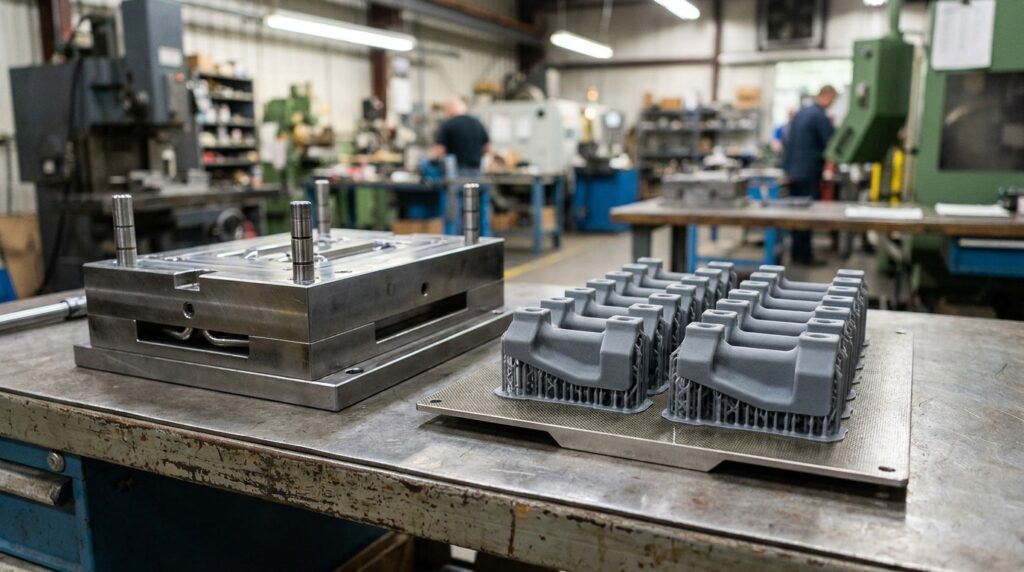
Somewhere between 500 and 10,000 parts, the math on cutting a steel mold stops being obvious. Below that range, almost nobody tools up. Above it, almost everybody does. The trouble lives in the middle — the high-stakes stretch where most real production decisions actually get made, and where the wrong call quietly costs the most.
That middle has a name: bridge manufacturing. It is the production phase between your first working prototype and your first ten thousand units, and it is exactly where 3D printing has gotten good enough to take work that used to default straight to tooling. Here is how we think through the decision when a customer brings us a part that lives in that range.
The volume where tooling stops making sense
Injection molding is cheap per part and expensive to start. A production-grade mold for a moderately complex part runs anywhere from $12,000 to $40,000 and takes weeks to cut and tune. None of that shows up in your per-part price — it is amortized across every unit you run. Make a million parts and the tooling cost rounds to nothing. Make a thousand, and it is the only number that matters.
3D printing inverts that. There is no tooling, so the first part and the thousandth cost roughly the same. That flat cost curve is the entire point. Recent cost modeling now puts the crossover — the volume where molding’s per-part savings finally pay back the mold — as low as 500 parts for some geometries, climbing higher for simple parts that mold many to a cavity. The honest answer is that the crossover depends on the part. The useful answer is that it sits a lot lower than most people assume, and it has been falling as printers get faster and materials get better.
What “bridge manufacturing” actually means
The term gets thrown around loosely, so it is worth being precise. Bridge manufacturing is real production — functional, end-use parts in real materials — spanning the gap between proving a design and committing to hard tooling. It is not prototyping. The parts ship. They go into products, onto machines, out into the field where they have to survive.
The materials are what make this possible. A bridge part is not a soft prototype in a brittle display resin. It is nylon that flexes without cracking, rigid photopolymers that hold a thread, glass-filled materials that take heat and load. When the printed part performs like the molded one would have, the only thing tooling really buys you is unit cost at volume. Which brings every one of these decisions back to volume.
What makes bridge production its own phase is uncertainty. At low-to-medium volume you usually do not yet know three things for certain: whether the design is truly final, whether demand will hold, and whether the part will need a revision once customers get their hands on it. Tooling forces you to answer all three before you have earned the right to. Printing lets you defer them until you have real information.
The cost of being wrong about volume
A mold is a bet on a forecast. You are spending real capital today against units you expect to sell tomorrow. When the forecast holds, it is a great bet. When it does not, the failure modes are expensive, and they all run in one direction.
Demand lands lower than projected, and the per-part savings never materialize — you have sunk $30,000 to save forty cents a part on a run that turned out to be 2,000 units. Or the design needs a change, and now you are modifying steel or cutting a new mold. Or a part comes back from the field with a problem, and your tooling has become a liability instead of an asset. Printing does not make those risks vanish, but it keeps you liquid while you find out which way they break. A revision is a file change, not a capital request.
Where printing hands off to molding
This is not an argument that printing wins everywhere. It does not. Once a design is locked, demand is steady, and you are running well into the tens of thousands, injection molding is hard to beat on cost per part and on piece-to-piece consistency. The same economics that make tooling painful at 1,000 units make it obvious at 100,000.
The mistake is treating that handoff as a one-time fork in the road. It is a sequence. Plenty of parts should start on printers and move to tooling later — printing the first several thousand while the design settles and the order book firms up, then cutting a mold once the volume is proven and the risk is gone. You get parts in weeks instead of months, you protect your cash while the design is still moving, and the mold you eventually pay for is one you actually need.
How we would run the decision
Four questions usually settle it. What is the realistic annual volume, not the optimistic pitch-deck number? Is the design frozen, or still likely to change in the next year? How much is lead time costing you right now? And how much would you trust the demand forecast with your own money?
If volume is genuinely high, the design is locked, and demand is proven, cut the mold and do not look back. If any one of those is still a question mark, bridge it with printing until it is not. The mold will still be there when your volume earns it. The real question on the table is rarely “print or mold” — it is whether you actually know your volume yet. When the honest answer is not yet, you usually have your answer.
Ready to see what your part would cost? Upload a CAD file for an instant estimate, see what we run on our capabilities and materials pages, or talk to a real person about your project.