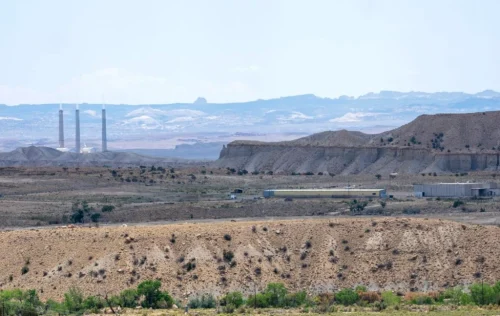
In February, a U.S. Air Force C-17 landed at Hill Air Force Base carrying something no military transport had ever delivered: a nuclear reactor. For most of the country, that was a novel headline that scrolled past. For us it was the neighbors. The reactor’s destination is Orangeville, Utah, a short drive south of our shop floor in Price.
We’ve spent the months since watching the story develop the way you watch news about your own town, which is to say closely, and with some skin in it. Nuclear power is coming to Utah coal country. Here’s what that looks like from inside the county lines.
What’s actually happening in Orangeville
The reactor is Valar Atomics’ Ward 250, a small test reactor being commissioned at the Utah San Rafael Energy Lab in Orangeville, in Emery County. It runs on TRISO fuel, which is worth explaining because it’s the detail that makes this generation of reactors different: the uranium comes as tiny kernels, each one sealed inside layered ceramic shells built to contain the fuel’s byproducts at the level of the individual particle. Pair that with helium cooling and graphite moderation and you get a design whose safety case is built into the fuel itself rather than bolted on around it.
Valar is one of eleven companies in the Department of Energy’s Nuclear Reactor Pilot Program, and the stated target is criticality, the point where the reactor sustains its own chain reaction, around July 4 of this year. Whether that date holds or slips, the fact that it’s plausible at all says something. A few years ago, a new reactor meant a decade of construction. This one arrived on an airplane.
The counties that powered Utah once already
It’s no accident this is happening here. Carbon and Emery counties have been energy country for over a century. The coal seams in these canyons powered the state, the power plants near Castle Dale and Huntington still anchor the grid, and the transmission lines that carried all of it are already in the ground and on the towers. When people here talk about energy, they aren’t speaking abstractly. It’s the family business.
The usual telling of the coal-country story is an elegy, and we’ve never had patience for that version. The people here didn’t stop knowing how to make energy. The market changed underneath them, and what was missing wasn’t skill or work ethic, it was the next thing to build. A test reactor at the San Rafael Energy Lab is not, by itself, an economic transformation. But it’s the right kind of seed in ground that’s ready for it: a workforce that understands shift work and high-consequence operations, infrastructure built for moving power, and counties that want the work.
Why AI’s appetite runs through rural Utah
The reason nuclear is moving this fast is sitting in your pocket. AI data centers are projected to need staggering amounts of electricity, the kind of always-on baseload demand that wind and solar can’t carry alone, and small modular reactors, compact plants built in factories rather than constructed on site over a decade, are the bet much of the industry is making to meet it.
That bet is a manufacturing story as much as an energy story. This same week the reactor news was circulating, the additive manufacturing trade press carried stories about printed components heading into small modular reactor programs. New reactor designs need parts, lots of them, in low volumes, iterated quickly, with documentation behind every one. Building dozens of small reactors in factories is precisely the kind of problem American manufacturing has to solve on the floor, not in a press release.
Where a shop like ours fits
A program in commissioning needs things constantly, and almost none of them are glamorous. Fixtures for assembly and test. Housings and brackets and ducting. Tooling that changes every few weeks because the process is still being figured out. One-offs and short runs where cutting a mold or waiting on a distant supplier makes no sense. That phase, fast-turn parts under real quality documentation, is what additive manufacturing is for, and it’s what we do every day for aerospace customers whose paperwork requirements look a lot like nuclear’s.
We hold AS9100, the aerospace quality standard, and the certification matters less as a plaque than as a capability: every part traceable, every process documented, every nonconformance run to ground. Energy programs need that same discipline from their suppliers. Having a certified manufacturing base twenty minutes up the highway from a reactor site, instead of two time zones away, is infrastructure too, just the kind that doesn’t show up in groundbreaking photos.
For a hundred years, this ground sent coal up the canyon and power across the state. Sometime soon, if the schedule holds, a reactor in Orangeville will go critical and the same ground will start making power a new way. Plenty about that future is still uncertain, but one thing isn’t: this time, when a new industry looks around for people who can build things, it won’t have to look far.
Ready to see what your part would cost? Upload a CAD file for an instant estimate, see what we run on our capabilities and materials pages, or talk to a real person about your project.