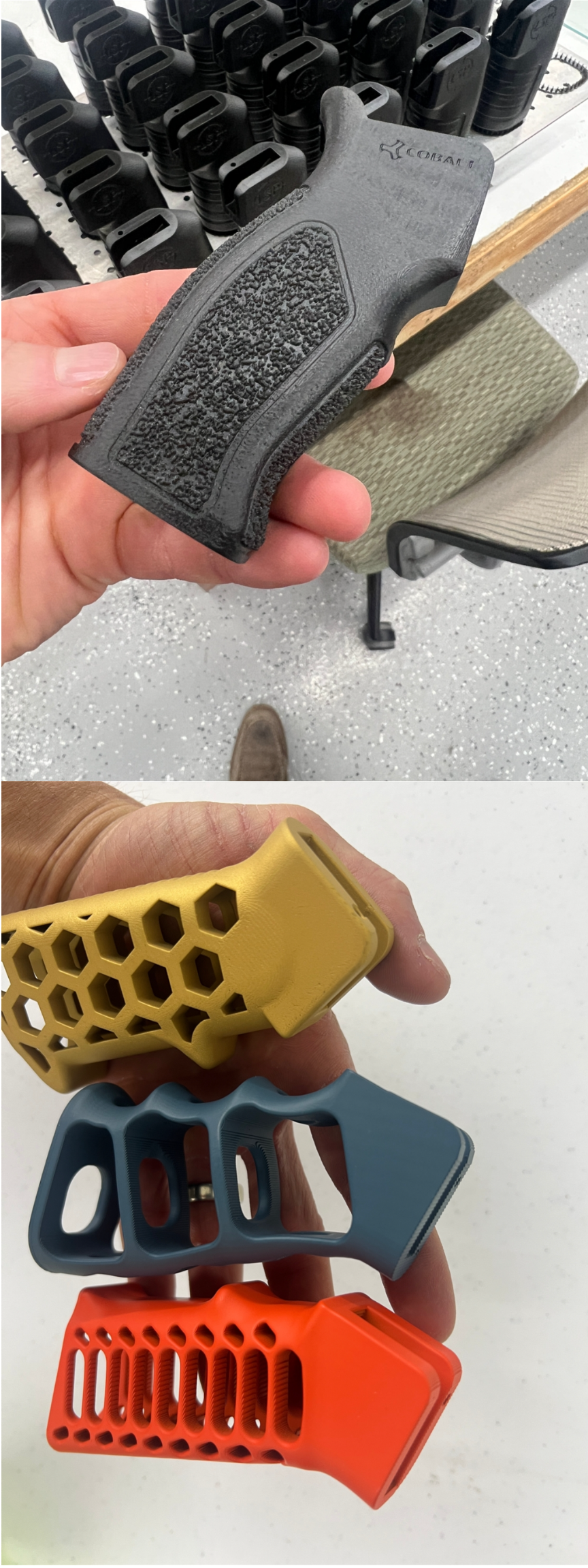
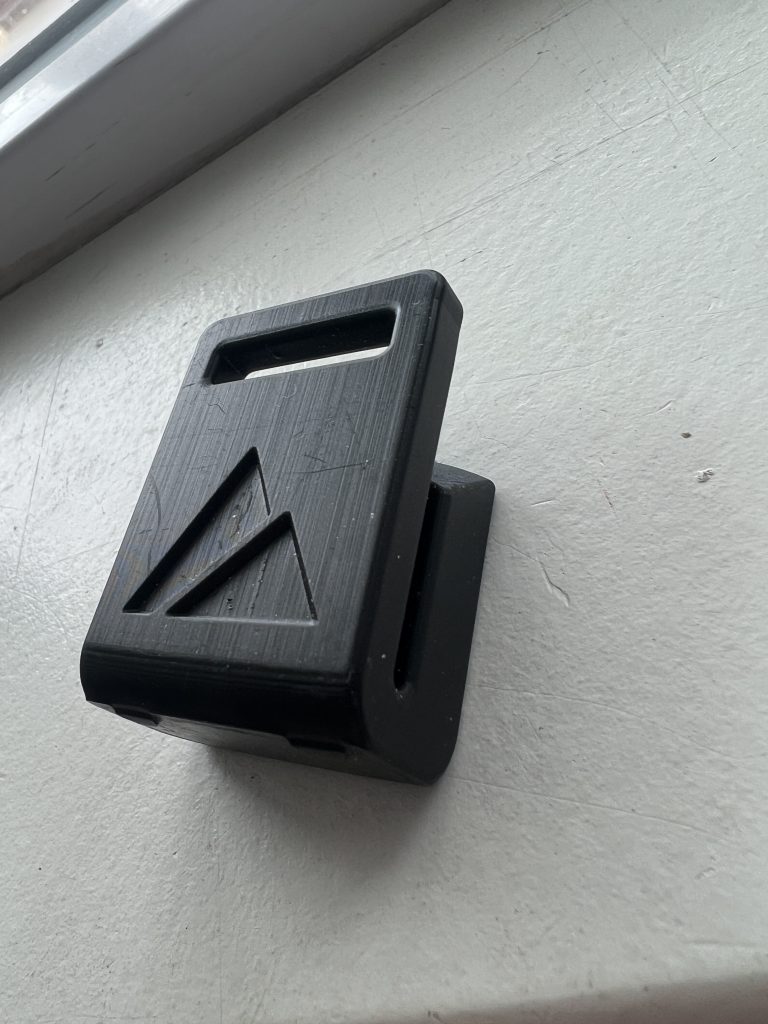
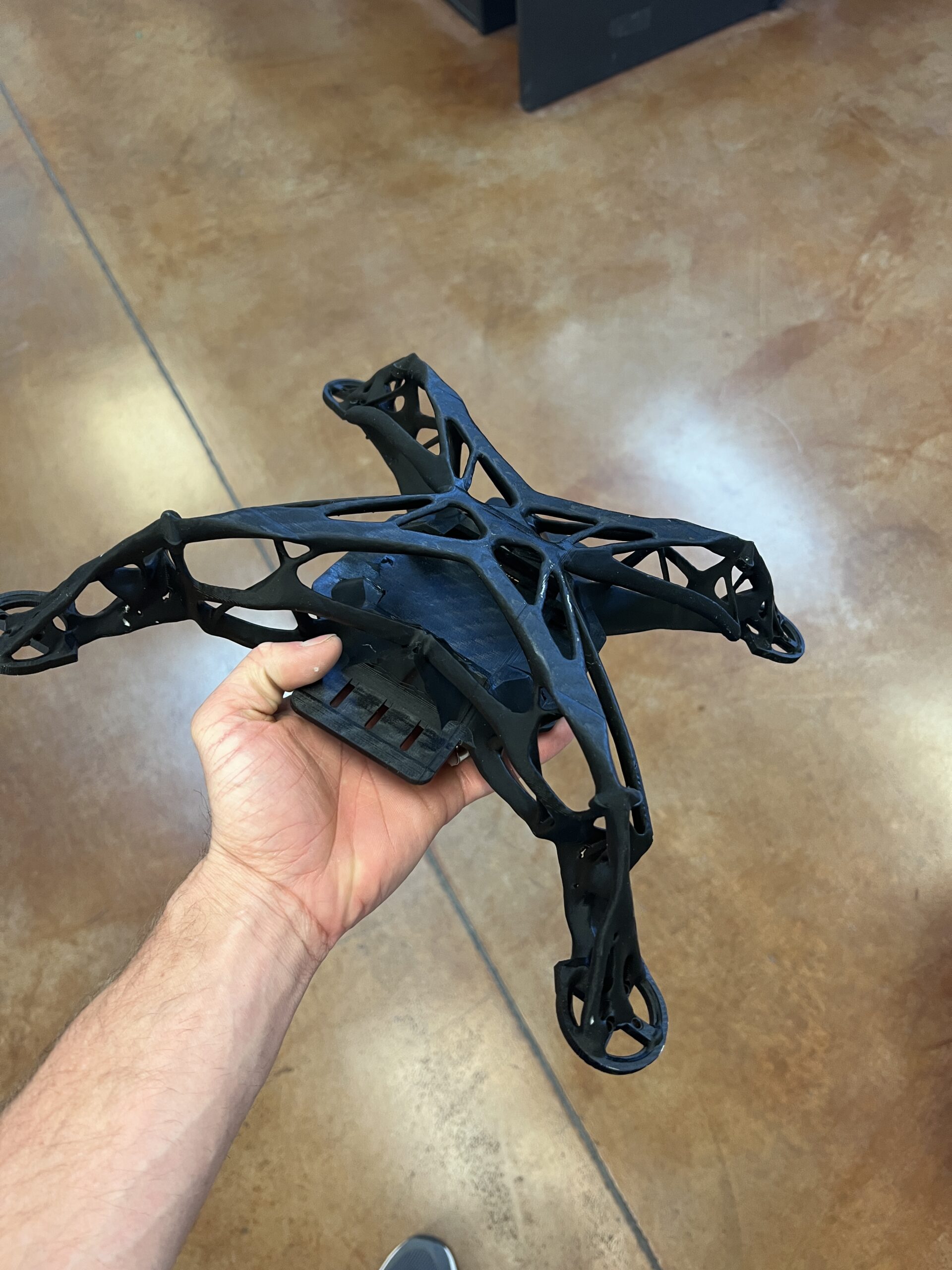
Spencer Loveless, our CEO, drops parts on the concrete for a living. Not literally — he runs the company. But on any given week, if a new part is coming off the Magna line, or a new material sample arrives from a vendor, or a customer flags a durability question about something already in production, Spencer will pick up the part, walk out onto the shop floor, and throw it at the ground as hard as he can. Gun grips. Vacuum housings. Enclosures. Almost every major part we make.
For a serious toughness check he graduates the test. A steel ball dropped from head height onto a vacuum-source housing tells him whether the material handles the abuse a real user will put it through. Sometimes the part survives. Sometimes it splits at a rib. Sometimes it shatters into four or five pieces at the far wall.
Spencer has been doing this since before we were AS9100-certified, and he keeps doing it now that we are. It is not a formal test. It is the way our CEO physically confirms that the material the sales sheet says is tough is actually tough. Every material we bring into production goes through the same filter, in one form or another. Before we run tensile numbers. Before we read the datasheet.
Why we throw parts on the floor before we read the MDS
Every material qualification textbook, every AS9100 auditor, every polymer engineer with a real degree will tell you the same sequence: pull the material data sheet (MDS), review tensile strength, elongation at break, notched impact, glass transition temperature (Tg), UV stability, chemical resistance, moisture absorption. They are all right. That work has to happen. We do it.
But not first.
The drop test is the first filter for three reasons, and they are all boring and practical.
It costs nothing. A tensile test needs a load frame, dogbone specimens machined to ASTM D638, and a technician who knows what they are doing. A notched Charpy impact test needs a pendulum instrument and correctly notched bars. Environmental aging takes weeks in a chamber we would rather use elsewhere. Throwing a printed part on concrete costs five seconds and the part.
It is honest about what production parts actually experience. The tensile test loads a specimen slowly, in one direction, at controlled temperature and humidity. The shop floor loads parts in every direction, at unpredictable speed, after they have been handled, boxed, shipped, and dropped from waist height by someone on their fourteenth hour of the week. If a material cannot survive our floor, it will not survive the customer’s floor. The datasheet does not know that. The concrete does.
It captures failure modes the datasheet averages out. An MDS reports mean tensile strength across a batch of lab-perfect specimens. It does not tell you whether the material fails brittle or ductile, whether it splits along layer boundaries or through them, whether the post-cure was actually complete or the interior is still green. The drop shows you all of that in one hit.
What the drop actually tells us
Watch the failure, not just whether it broke. That is the whole test.
A part that survives cleanly, or dents and stays intact, is a candidate. A part that shatters into eight pieces is not — the material is too brittle for handling loads, regardless of what the tensile number says. A part that fails at a stress concentrator — a screw boss, a thin rib, a filleted corner — tells us where the material’s real weakness will show up on customer parts. Because SLA (stereolithography, including the LCD process our Magnas run) crosslinks chemically across layers and SLS (selective laser sintering) fuses nylon fully across the powder bed, a properly-processed part behaves close to isotropic — so when we do see a failure that follows a specific layer boundary, that is a signal the cure or the sinter did not finish, not a fundamental material weakness. Either way, the failure mode tells us more than the tensile number does.
A part that looks fine outside but rattles when you shake it has an interior post-cure problem. LCD (liquid crystal display, the process the Magna uses to selectively cure resin one layer at a time) can leave a green core inside dense sections if the exposure or the post-cure lamp cycle is not tuned. The drop finds the ones where the shell is hard but the middle is still soft. The MDS does not report that. The floor does.
If the datasheet says the resin is high-impact and the drop finds a screw boss that shears clean off, the impact number was measured somewhere the customer never actually loads the part.
What comes after the drop
Everything the textbook says. Just later, and only for materials that earned it.
Materials that pass the drop go into the real qualification path. We pull dogbones and run tensile per ASTM D638 to confirm the vendor’s numbers are honest at our print orientation. We run notched impact if the part will see shock loads. We dimensional-check a batch across a week to see whether the material holds tolerance as our shop humidity swings. We run accelerated aging on parts that will sit in a warehouse for six months before install, and chemical soaks if the part touches solvents.
All of that costs real money and real time. The material has to be worth it. The drop decides which materials are.
The economics of qualification
At any given time we are looking at three to five candidate materials — new resin formulations for the Magna fleet and new powder blends for SLS (selective laser sintering). Vendors send samples faster than we can seriously evaluate them.
If we ran the full qualification stack on every candidate, we would spend more of the year testing materials than making parts. So we filter. Cheap filters first, expensive tests second, production release third.
The drop is filter one. Sanding, drilling, and tapping are filter two — a lot of resins print fine and then chip out when you try to modify them. Print consistency across a full build plate is filter three — some materials print beautifully in the sweet spot and get soft at the edges, which kills you at production volume.
By the time a material reaches the tensile bench, it has already survived three cheap tests. The expensive-test budget goes to candidates that deserve it. Keep the funnel narrow enough that the finish line is affordable.
What this looks like from the outside
It looks unprofessional. A rep comes in with a laptop full of validated lab data and the first thing the shop does is throw a printed block at the concrete. I understand how that reads.
But we are not pitching. We are running production for aerospace, defense, medical, and firearms customers who care whether the part works, not whether the qualification path looked tidy on a slide. AS9100 does not require you to test in textbook order — it requires a documented, repeatable, evidence-backed qualification process that catches materials which will not perform. Ours starts with a drop, logged with the same part geometry, drop height, and pass/fail criteria as the tensile tests that follow. It is repeatable. It generates evidence. It catches materials the datasheet lets through.
Boring for the datasheet. Useful for the floor. That is what production material qualification looks like when you are actually running volume, not writing about it.
Ready to see what your part would cost? Upload a CAD file for an instant estimate, see what we run on our capabilities and materials pages, or talk to a real person about your project.