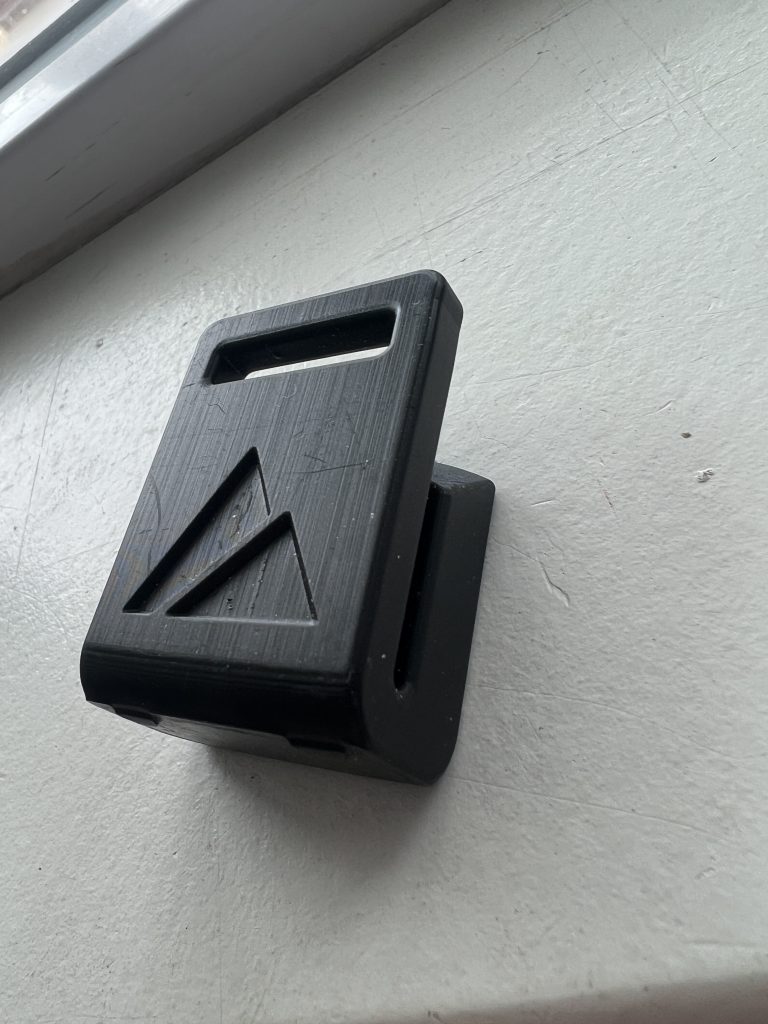
Adhesive Technologies sells epoxy in just about every hardware store in the country — Lowe’s, Home Depot, the independents. Every epoxy tube ships with a small hanger that clips the mixing nozzle to the tube. Small part, huge quantities, and for years the economics said the same thing they say for most parts like it: tool it overseas, mold it overseas, ship it over, hope the demand forecast holds.
They wanted it made in the United States instead. That’s the whole case study, really — the rest is how the math got there.
The problem
A hanger like this is exactly the kind of part injection molding was built for: simple geometry, enormous annual volume, commodity plastic. Overseas labor rates plus amortized tooling made the landed cost hard to argue with. Re-shoring it meant matching that cost structure without the cheap labor — which meant automation had to do the work, and the per-part price had to hold up against a mold that already existed.
What we did
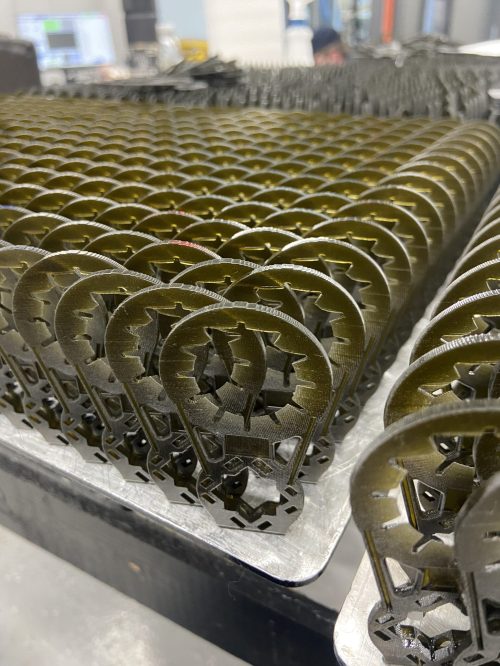
We were in negotiations with Adhesive Technologies right as Merit3D received funding from the $10 million Utah Manufacturing Modernization Grant. That funding went into robots and automation equipment wrapped around our Photocentric Magna fleet — the machines that make tiny-part mass production viable. The design team worked the part until quality and target cost both landed, and Adhesive Technologies placed what we believe may be the largest order of 3D printed parts ever: over one million pieces, delivered at 40,000 parts per week.
The numbers
- First order: 1,000,000+ parts
- Delivery cadence: 40,000 parts per week
- Design to production: 2 weeks
- Tooling purchased: none — production re-shored from overseas molds
- Durability: exceeds the HDPE equivalent it replaced
The part kept improving mid-run
This is the piece a mold can’t do. The first 50,000 pieces were one design. The next 100,000 were an improved design. After 500,000, another improvement was planned. Three design generations inside a single production order, at no tooling-modification cost, with development measured in weeks. With a mold, each of those revisions is a $2,000–$8,000 modification or a new tool entirely — we walked that math in 3D printing vs injection molding: the volume math that wins.
“It’s always very hard competing overseas because of the low cost of manufacturing,” said Spencer Loveless, Merit3D’s CEO, “but now that we were able to invest in high tech equipment, we’ve taken a giant step forward in leveling the playing field.”
Traditionally, any order in the 50,000–250,000 range defaulted to injection molding without a second thought. This order set a different precedent: a commodity part, at commodity volumes, made in Price, Utah — on demand, revision-friendly, and without a container ship in the loop.
Have a part stuck overseas? Upload a CAD file for an instant estimate, check the crossover math, or talk to a real person about re-shoring it.