Alaska Guide Creations is an outdoor gear company about five minutes from Merit3D’s shop in Price, Utah. They make bags for binoculars, gear for hunting, and accessories that move outdoor equipment off your hands and onto your body. In 2021 we announced a partnership with them on a hook and a binocular tether. Five years later, the partnership is still running — and one product in particular shows what additive manufacturing actually does for a specialty outdoor brand at production volume.
The part: a belt-clip that carries a bow
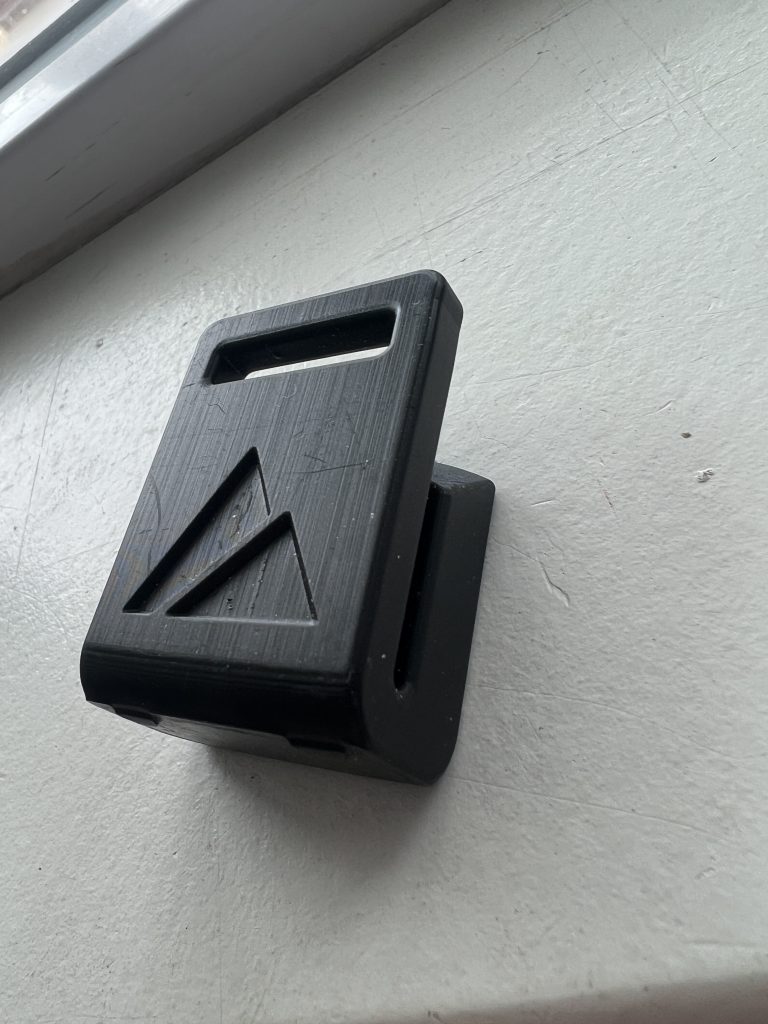
The product is a clip that attaches to a hunter’s belt and holds the riser of a compound bow. The clip’s job description is simple — keep the bow’s weight off your hands while you’re moving — but the design has to do several things at once. It needs to hold the bow securely without dropping it. It needs to release on demand. It needs to survive a season’s worth of weather and abrasion. And it needs to look like something Alaska Guide would put their name on.
That last point is where the manufacturing story gets interesting. Most outdoor brands handle “looking like ours” by molding a plain part and then adding the branding in a secondary step — a pad print, an etched label, a riveted patch. Each step costs money, adds a yield risk, and ties up an extra production line. For a low-to-mid-volume custom product, the labeling step is often a bigger headache than the part itself.
Branding as geometry
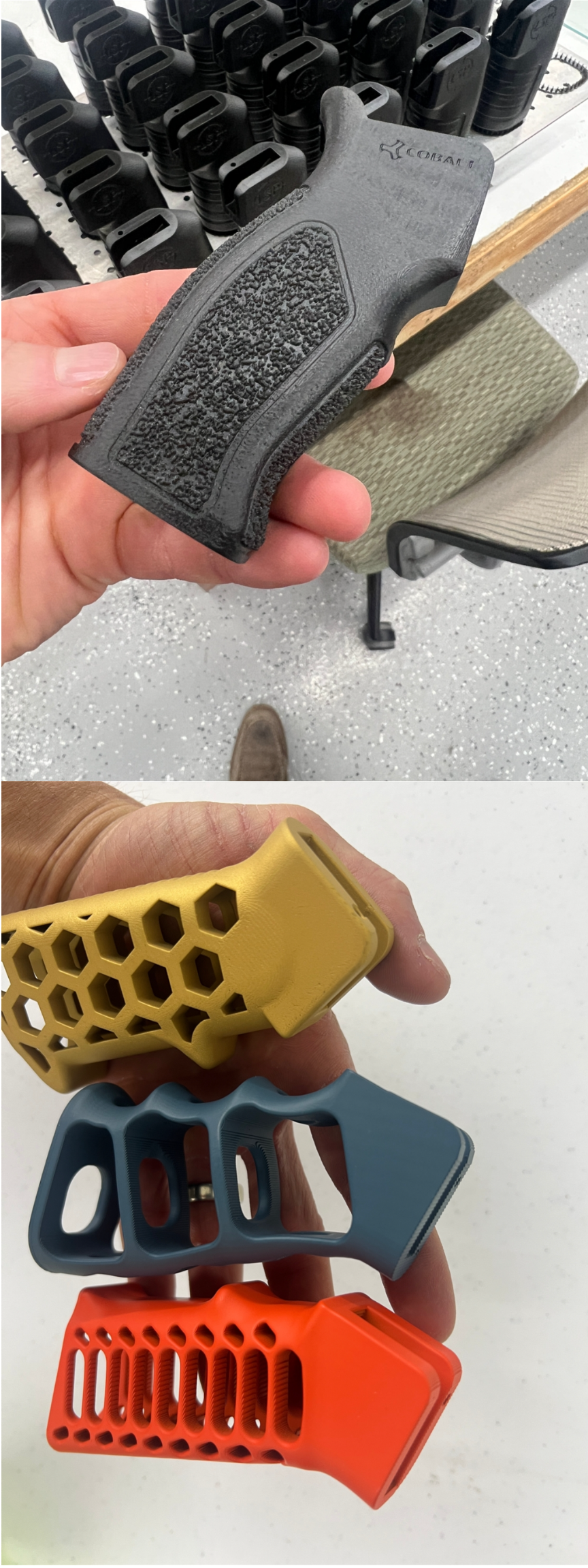
The bow belt-clip we produce for Alaska Guide doesn’t have a label. The Alaska Guide logo is printed directly into the part’s surface, as a geometric feature of the model. The grip texture that gives the clip its hand-feel is also printed into the geometry — not added in a secondary tumble or coating step. Everything that makes the part recognizably Alaska Guide is in the print file.
This isn’t a marketing optimization. It’s a cost-and-time optimization. The single SLA (stereolithography) print step produces a finished, fully-branded, textured part. There’s no second station, no labeling consumable, no secondary yield risk from a print head that ran out of ink halfway through a run. The part comes off the printer as the part that ships to Alaska Guide’s warehouse.
For a customer running their own production schedule on the customer side, that simplification compounds. Order placed Monday, parts off the printer mid-week, shipped to a warehouse a few miles away by Friday. The whole supply-side timeline for a custom-branded mechanical part collapses into a single week.
SLA on a Photocentric Magna
The clips run on a Photocentric Magna SLA system in a durable photopolymer resin. The Magna’s build envelope lets us nest several dozen clips on a single plate, each with the Alaska Guide branding and texture built into the geometry. A typical production run cures multiple plates back to back, with the only between-run change being the file selection on the printer’s queue.
The choice of SLA over an extrusion-based process (FDM) and over selective laser sintering (SLS) was specific to what this part needs. SLA gives a surface finish good enough that no post-processing tumbler is required to make the logo and texture read cleanly. The resin is rigid and impact-resistant enough for the part’s mechanical job. And the print resolution captures the texture detail in a single step — no secondary surface treatment needed.
None of this is exotic process work. It’s straight production SLA, executed at volume against a stable design. What makes it work for Alaska Guide is that the production economics map cleanly to their volume. They aren’t ordering 100,000 clips a year — and they don’t have to pretend they are to make the math work.
What this would have looked like with tooling
The traditional manufacturing path for a custom-branded clip at this volume would have started with a mold. The mold quote alone — for a part with both functional geometry and a logo cavity — would have come in around $20,000 to $40,000, with eight to sixteen weeks of tool lead time before the first part shipped. Then the labeling step: a separate pad-print or hot-stamp operation, either in-house at Alaska Guide or contracted out, with its own setup cost, tooling, and recurring per-part cost.
Once the mold existed, design changes would have been expensive — and the next revision to the clip (a strengthened tab, a different texture pattern, a logo update) would have meant either tool modification or a new tool entirely. The injection molding decision freezes the design.
The additive path skipped all of it. No mold, no labeling station, no tooling commitment, no design freeze. Alaska Guide can update the texture, the logo proportions, or the clip geometry at any time — and the next print run reflects the change. That flexibility doesn’t show up on a per-unit cost comparison, but it’s worth real money over a multi-year product cycle.
Five years of the same answer
What’s worth noting about the Alaska Guide partnership is how stable it has been. Most supplier relationships in additive manufacturing follow a pattern: a customer tries 3D printing for a prototype, then moves to a “real” manufacturing process for production. The Alaska Guide partnership has stayed in additive for production, year over year, because the math on this product class hasn’t changed.
The early conversations with Alaska Guide were about whether a local AM supplier could actually deliver production-grade parts at the quality and consistency a retail product line demands. After a few seasons of shipping, the answer settled into a steady state: yes, and the supply chain is a 10-minute drive instead of an ocean crossing. Reorders happen by email. Design tweaks happen in a phone call. The next batch ships the same week.
For Alaska Guide, the value isn’t just the parts. It’s the operating tempo a local AM supplier enables — short lead times, low minimum orders, design flexibility, and a working relationship measured in years instead of POs.
What this case generalizes to
Not every product fits this profile. A part that ships in the high tens of thousands per year, with a stable design and no custom branding, probably still belongs in injection molding. But a custom-branded mechanical part shipping in the low thousands per year, with periodic design refinements — that’s the additive sweet spot, and the math is increasingly hard to argue with.
If you’re an outdoor brand, a tool manufacturer, or any specialty maker sitting on a custom mechanical part where the branding step is bigger than the part itself, the question worth asking is whether the labeling problem could just disappear into the print. For Alaska Guide’s bow belt-clip, the answer was yes — and five years later, the parts are still coming off the printer in Price, Utah, branded, textured, and ready to ship.
Ready to see what your part would cost? Upload a CAD file for an instant estimate, see what we run on our capabilities and materials pages, or talk to a real person about your project.