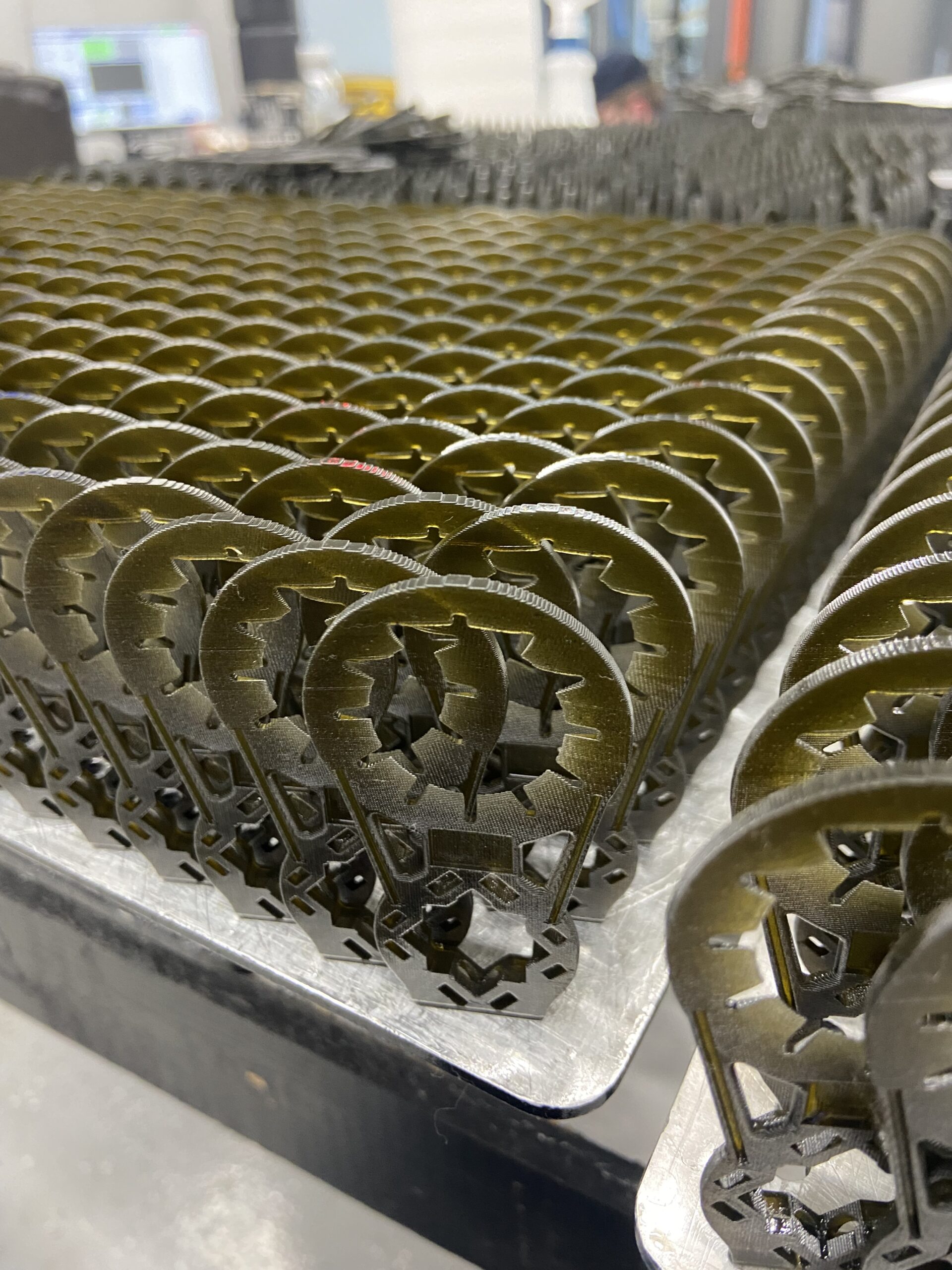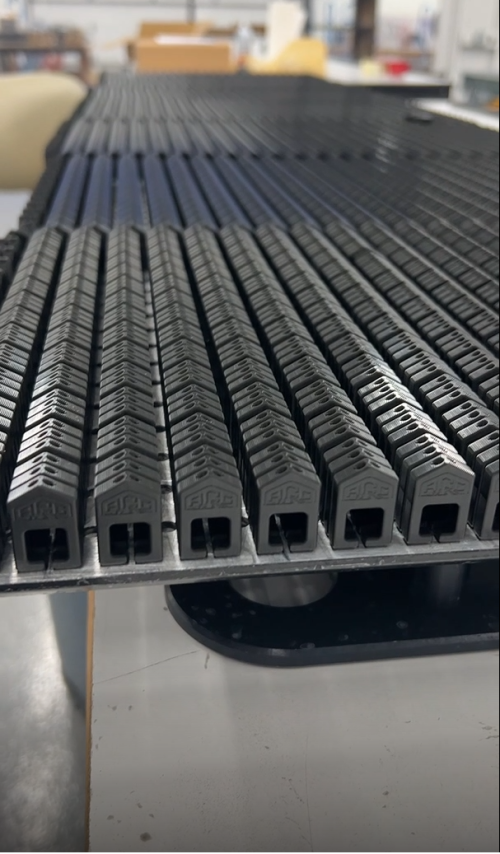
On January 25, 2022, we printed 60,000 side-release buckles in under eight hours. One part, one shift, one customer — Alaska Guide Creations, who build binocular harnesses and outdoor gear. It’s the production run we point to when an engineer asks, politely, whether “mass production 3D printing” is a marketing phrase.
Why a buckle
A side-release buckle is a real mechanical part: it has to flex, snap, hold under load, and survive cold. Alaska Guide Creations needed volume pricing and needed the part to be right — and their development loop with us ran in days, not tooling cycles. “We were able to go back and forth with Merit3D on multiple iterations within a single week,” said co-owner Zac Jones. Once the design settled, the question became whether additive could deliver production quantities on production timelines.
The run
The answer was the Photocentric Magna fleet running as a coordinated production line rather than a bank of prototyping machines — full build plates, staged resin logistics, post-processing keeping pace with the printers instead of queuing behind them.
- 60,000 parts in under 8 hours
- Functional end-use buckles, not display pieces
- Design iterations with the customer: multiple rounds inside one week
- Tooling cost: zero
“Completing 60,000 prints in under eight hours proves that we have the right scalability,” said CEO Spencer Loveless at the time. The run drew coverage from 3D Printing Media Network and ETV News.
What it means if you’re holding a mold quote
A day like that one is why the injection-molding crossover math has more variables than tooling-cost-divided-by-price-delta. If a resin part fits our machines, six figures a month is not a stretch goal — it’s scheduling. The honest version of when that beats a mold (and when it doesn’t) is in 3D printing vs injection molding: the volume math that wins.
Curious what your part runs at volume? Upload a CAD file for an instant estimate, or talk to a real person.