One of the most honest questions we get sounds like this: someone has a desktop resin printer on their bench, or a couple of Bambu FDM machines running in the corner, and the parts they need are printing just fine at home. Why would they send work to a shop like ours? We cost meaningfully more per part than a spool of filament and an entry-level machine. Something has to justify the difference.
It is a fair question, and it deserves an honest answer. Consumer and prosumer 3D printers have gotten remarkably good. A shop or a solo engineer can spend a few hundred to a few thousand dollars, hit twenty-five to fifty micron layer heights, and print parts that look great on a desk. Those machines are doing exactly what they were designed to do. The real question is what changes when you move from a handful of parts a week to a production requirement — and where the effort and cost of scaling in-house crosses the cost of just handing the work to a shop that already has the throughput.
The vocabulary, briefly
A few terms will come up repeatedly. SLA (stereolithography) is the broader family of resin printing that cures liquid photopolymer, a UV-sensitive plastic, one layer at a time. LCD (also called MSLA, masked stereolithography) is a variant where a screen selectively blocks UV light so an entire layer cures in one flash. Layer height is the thickness of each cured slice, in microns. Build volume is the interior space a machine can print inside. Throughput is how many parts come off in a shift. AS9100 is the aerospace quality standard for production suppliers. IPA is isopropyl alcohol, the solvent used to wash uncured resin off finished prints.
Build volume is the first honest difference
Most desktop SLA machines land around 150 by 80 by 160 millimeters of build volume. That is enough for a fistful of small parts, dental models, jewelry masters, miniatures. A real workspace, and it prints beautifully inside that envelope.
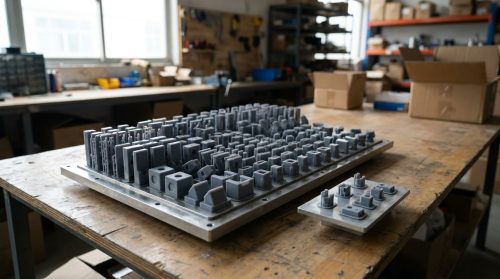
The Photocentric Magna prints inside a build area of roughly 700 by 410 by 200 millimeters. A full Magna plate is bigger than most desktop machines are, front-to-back and side-to-side. When we quote a production job, the first thing we look at is how many parts nest onto a single plate, because that number sets the economics of the whole run. A desktop machine has to run the same job in dozens of smaller builds, each with its own setup, wash, and cure.
Speed at volume is where the math changes
People often expect industrial LCD to be faster per layer. It is not, really. A layer either cures in the exposure time or it does not, and exposure times are close between tiers because the underlying chemistry is the same. What changes is what happens across an entire build.
A fifty-micron layer on a desktop machine cures in about the same time as a fifty-micron layer on a Magna. But the Magna is curing a plate that holds ten, fifty, sometimes a few hundred times as many parts inside a single exposure. Per-shift throughput on a small machine is measured in tens of parts. On a Magna, in thousands. That is the number that matters when a customer needs ten thousand by next month.
Materials range opens up at the industrial tier
Desktop SLA machines mostly run either a generic photopolymer or the printer manufacturer’s own branded resins. Those are good resins, but the range is narrow, and most of them are tuned for visual quality on small parts rather than engineering properties on production parts.
Industrial LCD opens the material menu meaningfully. On the Magna we run DL110HB, a high-impact rigid resin that holds up under real mechanical load. We run high-temperature resins that survive where a desktop resin would sag, ESD-safe formulations for electronics, and flame-retardant chemistries where the end use requires it. Photocentric’s Daylight resin family is engineered for the light intensity of industrial LCD, which is what lets these resins deliver properties generic desktop resins do not target. If the part needs a resin that only exists at the industrial tier, the desktop tier is not in the running.
Repeatability is what production actually pays for
Desktop and industrial LCD separate hardest not on the first part, but on the ten-thousandth. Desktop machines have real part-to-part variance across the build volume, and machine-to-machine variance across a small fleet. That variance is fine for prototyping. It is a problem when a customer’s incoming inspection is measuring every tenth part against a drawing tolerance.
Industrial LCD is engineered for tighter, more repeatable output. Temperature control across the vat, uniform light from the LCD screen, resin recirculation through a long build, and calibration protocols that are part of the machine’s operating procedure. None of that is dramatic on any single part. It shows up as a lower standard deviation across a batch, and in an AS9100-certified shop, that is what makes the parts shippable as production hardware.
Post-processing is a whole shop, not a countertop
A desktop SLA setup assumes a small IPA wash tank and a countertop UV cure chamber. That works fine when the plate is small and the operator has time. A production run does not work that way. When a Magna plate comes off with hundreds of parts on it, those parts move through industrial wash stations, cure ovens, support removal, inspection, and packaging, in a flow that does not stall the next print. The Magna is one station in a production line. Desktop SLA is a bench.
Support and certification
Two more differences worth naming. When a desktop machine breaks, the answer is usually a community forum, a replacement part in the mail, and a lost shop day. When a Magna has a problem, there is a service contract, an engineering point of contact, and options that include an on-site visit. That difference is invisible until it matters.
On certification: a part printed on a desktop machine, however good it looks, cannot be shipped as flight hardware. Traceability, process control, calibration history, and audit trail live inside a certified production system. An AS9100 shop running industrial LCD can produce parts that clear the paperwork. The desktop tier cannot. That is a boundary, not an opinion.
The cost-per-part comparison, done honestly
The naive version of this comparison looks at machine price and stops there. A desktop machine costs a fraction of a Magna, so it wins on sticker. For the right job, that is the right answer. If a shop needs a few dozen prototypes a month, a good desktop SLA is a strong investment.
The comparison changes when the denominator changes. Divide amortized machine cost, resin, labor, and post-processing by parts produced per shift. At prototype volumes, the desktop machine wins. In the low hundreds of parts per month, the two get close. At production volumes of thousands to millions of parts, industrial LCD wins by a wide margin, because the throughput denominator is one to two orders of magnitude larger.
The honest takeaway
Desktop SLA is not a bad tool. It is a good tool for the job it was designed for, and we say so plainly when it is the right answer. What we do at Merit3D is a different job: production volumes on industrial LCD, in engineered materials, with the process control and certification aerospace and medical customers require.
If the parts are small, the volume is low, and the resin choice is open, the desktop tier is capable and honest. If the parts need to ship at scale, in an engineered resin, to a tolerance that will not drift across a batch, the industrial tier stops being a luxury and starts being the shortest path to parts you can ship.
Ready to see what your part would cost? Upload a CAD file for an instant estimate, see what we run on our capabilities and materials pages, or talk to a real person about your project.