The list of resins we can print a regulated part in is longer this month than it was in the spring. By late summer it will be longer still. That pace — a steady stream of genuinely new materials, not just new colors — is one of the quieter but more important shifts in additive manufacturing right now, and it changes what you can responsibly say yes to.
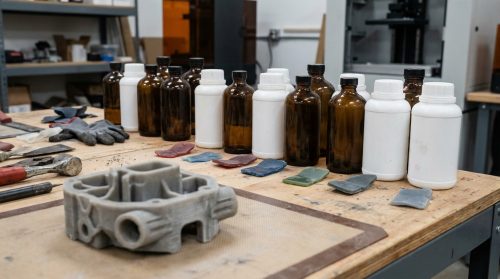
A photopolymer — a liquid resin that cures into a solid when light hits it — used to come in a handful of flavors: rigid, tough, flexible, castable. The menu in 2026 looks nothing like that, and the new entries are not novelties. They are materials that open doors into regulated work that used to be closed to printing entirely.
Why the catalog moves so fast now
New resins are reaching the market on a near-monthly cadence, and they are aimed squarely at applications with rules attached: photopolymers cleared for food contact, formulations for medical use, flame-retardant grades for electrical and transportation work, materials certified safe for toys. On the powder side — the materials used in SLS (selective laser sintering, where a laser fuses plastic powder layer by layer) — high-performance options keep expanding too, with PEEK, a tough and heat-resistant engineering polymer, creeping back into reach as the process challenges around it get solved.
It helps that the printers got there first. Vat photopolymerization processes like DLP (digital light processing, which flashes an entire layer at once with a UV light engine) are fast and repeatable enough for real production runs, so a new resin can go from interesting to shipping parts quickly. The hardware was ready for production volumes; the materials are what have been catching up, and lately they are catching up fast.
The reason behind all of it is straightforward: as additive moved from prototyping into production, the materials had to grow up to meet the applications. A prototype only has to look and feel right. A production part has to meet the same standards as whatever it is replacing — and a lot of those standards are written down and enforced.
Matching a resin to a real requirement
This is where a bigger menu helps, but only if you order from the right section. The requirement should pick the material, not the other way around.
If a part touches food, it needs a photopolymer that meets FDA food-contact requirements — not a material that is merely “non-toxic,” but one specifically evaluated for the kind of contact involved. If it has to resist ignition, the relevant target is usually a UL 94 flame rating, and the specific rating (HB, V-2, V-0) depends on the part’s role. If it goes in or on the body, biocompatibility under ISO 10993 is the bar, with different testing depending on contact type and duration. Each of these is a real, testable requirement with a material answer — and increasingly, that answer exists in a printable resin.
The cost of overspeccing
The opposite failure is just as common and quietly expensive: calling out more material than the part actually needs. A medical-grade resin on a bracket that never touches a patient. A flame-retardant grade on a part that lives nowhere near an ignition source. A high-temperature engineering polymer on something that never sees heat.
Overspeccing feels safe, but it is not free. The premium materials cost more per part. Some run slower or need extra post-processing, which adds lead time. A few carry real trade-offs in finish or detail that you are now paying for and not using. “Better than necessary” is still the wrong material if the requirement never asked for it. You are buying margin you will never spend.
What we ask before picking a material
A short set of questions usually narrows a sprawling menu down to one or two honest candidates. Does the part contact skin, food, or anything ingestible? What is the highest temperature it sees in service? What loads and impacts does it take, and how often? Is there a regulatory standard it has to meet — FDA, UL, ISO, a customer spec? Will it live in sunlight or UV, which ages some resins? Does it need a specific color, finish, or surface for its job?
Answer those and the material almost chooses itself. The expanding catalog is genuinely good news — more parts are printable in production-grade, compliant materials every month. But a bigger menu only helps the person who knows what they actually ordered for. The win is not the fanciest resin on the shelf. It is the one that meets the requirement, and nothing more.
Ready to see what your part would cost? Upload a CAD file for an instant estimate, see what we run on our capabilities and materials pages, or talk to a real person about your project.