
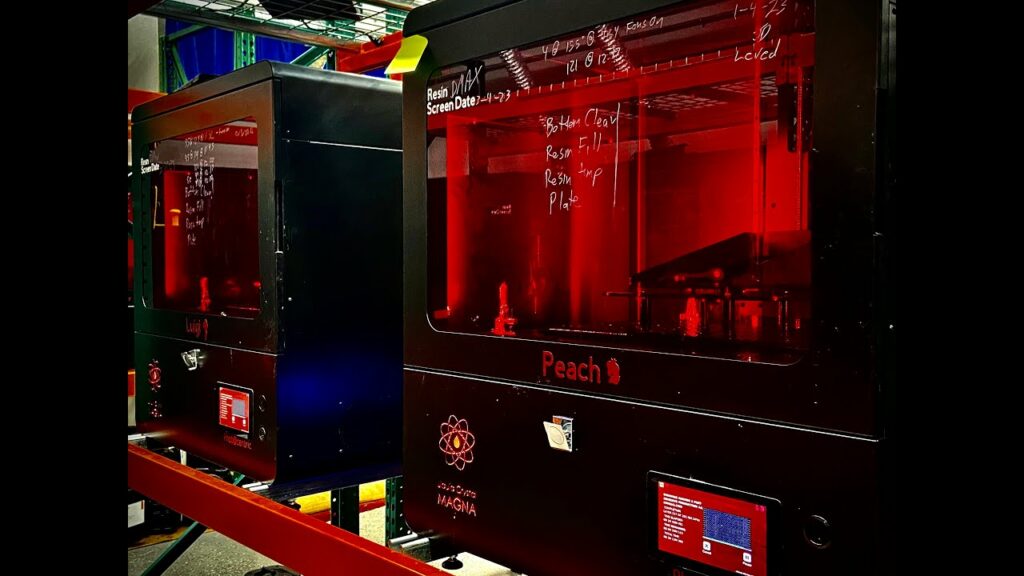
There is a printer running a production batch about twenty feet from a CNC mill in our shop. Most days nobody thinks twice about which one is supposed to be the advanced machine. They both have a job, a cycle time, and an operator who knows their quirks. One cuts material away; the other builds plastic up. To the part, the distinction does not matter. It just needs to be right.
I think about that whenever I read predictions about where additive manufacturing is headed. The forecasts keep describing a future that, from where I am standing, already arrived.
The forecast everyone is quoting
There is a popular line in the industry right now: 3D printing is heading for “infrastructure invisibility.” The idea is that additive will stop being a category of its own and simply become manufacturing — printers sitting on the floor next to lathes and mills, chosen for a job the same way you would choose any process. One executive put it plainly: there will not be a 3D printing industry, there will just be manufacturing. The technology succeeds, in this telling, precisely when people stop noticing it.
It is a good prediction. I would only add that for shops actually running production on these machines, it is not a forecast. It is Tuesday.
We already run it that way
On our floor, a printer is a production asset, not a science project. It has a takt time — the pace it has to hold to keep an order on schedule. It has a quality gate that parts pass or fail at. It has preventive maintenance, consumables, an operator rotation, and a spot on the schedule it has to earn against everything else competing for the hours.
That framing changes how you treat the machine. You stop asking “isn’t 3D printing amazing?” and start asking the boring, useful questions you would ask of any process. What is the cycle time per plate? What is the yield? How many parts nest in a build before the economics shift? What does it cost, all in, to make one good part and get it out the door? Those questions do not make for exciting headlines. They make for a business.
The operators are the tell. The people who run our printers do not talk about them the way early adopters used to. They talk about them the way a machinist talks about a mill — what it is good at, where it bites you, the trick to getting a clean result on a difficult geometry. That shift in how the people on the floor talk is, to me, the clearest sign the technology has grown up. Reverence is for new things. Competence is for tools.
What “invisible” really costs
Here is the part the forecasts tend to skip: making a technology boring is a lot of work. Invisible infrastructure is invisible because somebody did the unglamorous work of making it reliable, and printing is no different.
Repeatability is the hard-won kind. Getting one beautiful part off a printer is easy; getting the four-hundredth to match the first takes process control, environmental control, and discipline about the variables that drift. Traceability is its own project — knowing which machine, which material lot, and which parameters produced a given part, and being able to prove it. For us a lot of that lives under AS9100, the aerospace quality standard, which in plain terms means documenting what you did well enough that someone else could audit it and trust the result. None of that is exciting. All of it is what turns a printer from a cool demo into a machine you can build a delivery promise on.
Software eats the spec sheet
The same forecasts argue the long-term winners in additive will not be the hardware makers but the software and data platforms — that the economics of the factory will be defined by the system around the machine more than the machine itself. From the floor, that rings true. The printer brand matters less than people think. What matters is the production system wrapped around it: how jobs get scheduled and nested, how quality data gets captured, how a file becomes a planned, priced, traceable part without a person babysitting every step.
That is the unglamorous truth of where this is going. The interesting part of a mature manufacturing process is not the machine in the middle of it. It is everything you built around the machine so the machine could become ordinary.
The goal was always boring
We never set out to make 3D printing exciting. We set out to make it dependable — reliable enough that the part, not the process, is the interesting thing in the room. When a customer stops asking how we made their part and starts asking only whether it is right, on time, and the price they expected, that is the win. That is the technology disappearing into the work, exactly like the forecasts say it will. It does not feel like a revolution from the floor. Just a machine doing its job, twenty feet from the mill.
Ready to see what your part would cost? Upload a CAD file for an instant estimate, see what we run on our capabilities and materials pages, or talk to a real person about your project.