
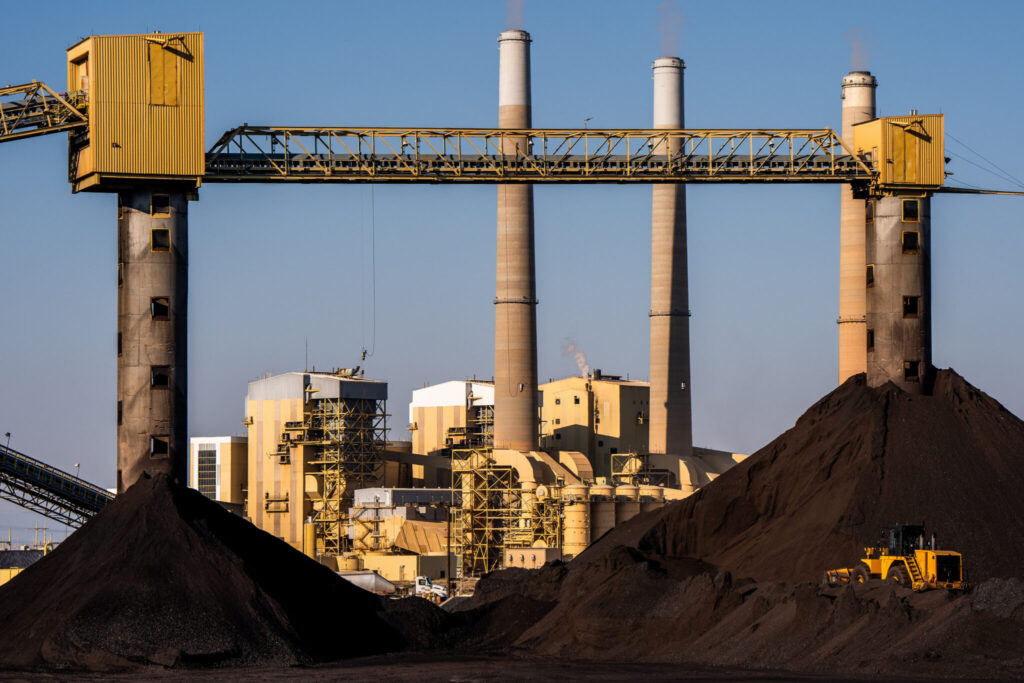
Earlier in 2026, a turbine failure took the Sunnyside coal plant offline for what may turn out to be the rest of its operating life. A few months later, the U.S. Air Force quietly decided to outfit its entire C-17 fleet with 3D-printed parts. Those two stories aren’t usually told together. They probably should be.
Both happened inside a six-month window. Both were reported as routine industrial news — one a regional energy footnote, the other a defense-procurement update. Read separately they’re unremarkable. Read together they describe a real change in where America makes things and what it takes to make them at scale.
Merit3D builds polymer additive manufacturing parts in Price, Utah, in a county whose name comes from what we used to dig up here. The conversations about reshoring and the conversations about energy transition are usually held in different rooms. From this room they look like the same conversation.
The end of generation, the start of nothing yet
The current chapter started last November. On the day before Thanksgiving 2025, the coal-fired generators at the Intermountain Power Plant — sited in Delta, west of here — stopped producing energy, as the plant’s owners moved to a gas-and-hydrogen replacement project under a contract running through 2077. The Sunnyside Cogeneration Facility, on the Carbon County side of the line, has been offline since fall 2025 on a turbine failure that may not get repaired. Earlier this year, the Utah Legislature began building a special district designed to find buyers willing to restart IPP’s idled coal units. Whether that works is its own story.
Carbon County itself hasn’t produced coal since 2020 — the Carbon Power Plant closed a decade ago, and the county raised its municipal services tax 700 percent to make up the lost royalty base. Across the line in Emery County, the Hunter and Huntington plants are still running. PacifiCorp’s most recent integrated resource plan pushed their assumed retirement dates out to no earlier than 2045, against prior schedules of 2036 for Huntington and 2042 for Hunter. That’s still a finite calendar.
Meanwhile, rPlus Energies’ Green River Energy Center is coming online this spring on 3,000 acres north of Moore — 400 megawatts of solar paired with 400 megawatts of four-hour battery storage. The construction phase employed around 500 people. The permanent operating staff, once the project is online, is projected at 10 to 15.
That last number is the one rural Utah keeps not getting answered. The energy transition is real, and on its current schedule. The employment transition is not. Coal generation in Carbon and Emery counties has historically supported more than 400 direct plant jobs and thousands of indirect roles in mining, trucking, rail, and equipment maintenance. Solar and storage do not employ at that density, and they don’t draw on the same upstream supply chain. The diversification timeline does not match the depopulation timeline, and the calendar everyone is working against has dates on it now.
What additive crossed in 2026, while no one was looking
The other story is the one the industry has been hinting at for a decade and finally got to say plainly this year. Additive manufacturing left the demonstration phase.
The clearest signal is the U.S. Air Force’s announcement in June that it plans to deploy 3D-printed microvanes — small aerodynamic blade-shaped inserts that reduce drag and recover meaningful fuel efficiency — across its entire C-17 fleet. The Air Force Lifecycle Management Center developed and qualified the devices on test aircraft, and the fleet-wide rollout is the next step. That is the verb the AM industry has been chasing: rollout.
The rest of the month read the same way. Beehive Industries committed $50 million to install 30 EOS M4 ONYX metal AM machines, scaling production of its Frenzy 8 drone engine line against a $29.7 million Air Force propulsion contract. Continuous Composites picked up a multi-year contract supporting the U.S. Army DEVCOM Aviation and Missile Center, applying fiber-steered composite printing to missile-platform components. Meltio announced a slate of U.S. defense partnerships — Force Automation, Snowbird Technologies, Phillips Corporation, Fastech — built around ITAR registration and cybersecurity compliance as table stakes, not differentiators. Phase3D closed a $2.9 million round for in-situ structured-light defect detection on metal AM, with NASA and the Air Force already qualifying it. And Norsk Titanium’s engineering VP went on the record about supplying structural titanium AM parts to both Airbus and Boeing on production programs.
The unifying thread isn’t any one announcement. It’s that fleet-level deployment, production-volume buys, and certified supplier integration all showed up in the same six-week window — and from different ends of the supply chain at once. Aerospace primes are buying. The DoD is buying. The qualification work that made those buys legible has been climbing for years. This was the moment the curve crossed.
Where the materials come from matters again
The same window produced a quieter materials story that’s worth telling alongside it. Foundation Alloy raised $22 million in Series A to scale a solid-state molybdenum production process that doesn’t require melting, aimed at refractory alloys for defense and aerospace where overseas supply currently dominates. AIMMS — a Marine Corps point-of-need additive manufacturing program — fielded transportable metal AM cells designed to repair components forward, without waiting on a supply line. Both are about the same thing: the United States rebuilding the materials pipeline upstream of the part, because the part is only as resilient as where its inputs come from.
That conversation usually pulls toward the coasts. It probably shouldn’t.
Carbon County’s own economic-development materials name the production of carbon fiber and coke from local coal as a target industrial use. Carbon-fiber-reinforced polymers are an active class of additive-manufacturing materials — composites used across aerospace, defense, and high-performance industrial applications. If a carbon-fiber pipeline ever gets built out of Utah coal, the supply chain for advanced composites starts in the same ground that powered the last industrial era. Same county. Same atoms, in a different form. Different century of work.
It’s an unproven bet. The chemistry, the capital, and the offtake all have to land. But it’s a bet the county itself has been making, on paper, for years, and the materials-resilience conversation now has the political and capital tailwinds it needs.
The job math doesn’t pencil unless manufacturing comes back
Step back to the labor-density gap between coal generation and solar generation. It is not an argument against renewables. It is an argument about what renewables do not, by themselves, replace.
A 400-megawatt solar farm employs at a different density than a 400-megawatt coal plant for the same reason a wind farm employs differently than a refinery. Once a renewable plant is built, the marginal labor required to keep it producing electricity is small. That is part of what makes the unit economics work. It is also why “the renewable buildout will replace the coal jobs” was never going to land in a coal county on a one-to-one basis — not at the plant, and not in the upstream mining, trucking, and rail jobs that a coal plant draws on but a solar plant does not.
The sector that does re-employ at small-county density is manufacturing. And within manufacturing, polymer and metal additive in particular have a labor profile that fits places like Price. A working production cell needs six to twelve people to run a shift. The capital expense per cell is bounded — measured in the hundreds of thousands of dollars for polymer printers, low millions for metal systems — not the seven- and eight-figure tooling programs that legacy injection-mold mass production requires, and far below the nine-figure outlays that a new semiconductor or chemical fab carries. The cell can be planted next to industrial workforce, existing rail or trucking infrastructure, and reliable power, without needing a port. Carbon and Emery counties have all three.
The way an additive shop scales is also different. It scales by adding cells. A polymer shop doubles capacity by adding printers and operators, not by retooling. That looks small from the national-news distance. From a county that needs to add manufacturing employment in increments it can actually absorb, it is exactly the right shape.
What SERDA, Emery, and Carbon are asking for is happening in Price
The Southeastern Utah Regional Development Agency is working on the “what comes next” question for the post-coal counties. The Emery County Economic Development Board is putting together asset packages and looking at engaging marketing or recruitment firms to bring industry into the local industrial park. Both moves are correct. Both are the kind of work rural economic development has been doing for forty years.
The quiet point is that the answer being asked for is one factory over.
Merit3D did not land in Price on a recruitment grant. Polymer additive crossed the same threshold this year that metal additive is crossing — production volume, certified parts, industrial pricing — and when production AM looks at where to plant a cell, the criteria are the ones already on the ground here. Industrial workforce who know shift work and tolerances. Existing infrastructure. Power. Real estate. And the absence of the kind of overseas inertia that keeps a lot of legacy mid-sized manufacturers from changing what they do.
What’s happening here isn’t a story Merit3D needs to tell about itself. It’s a story the policy conversation about reshoring needs to be able to point at. The reshoring conversation has to land somewhere. It is landing here. That is worth saying out loud, calmly, while the other counties figure out their own version of the same answer.
Carbon County produced the energy that ran the last industrial era. The geological and demographic facts that made it useful then have not changed: layered carbon under the ground, a small population that knows industrial work, infrastructure that already moves material. What has changed is what the country needs from those facts.
That isn’t a thesis about Merit3D. It’s a Tuesday on the shop floor.
Ready to see what your part would cost? Upload a CAD file for an instant estimate, see what we run on our capabilities and materials pages, or talk to a real person about your project.